
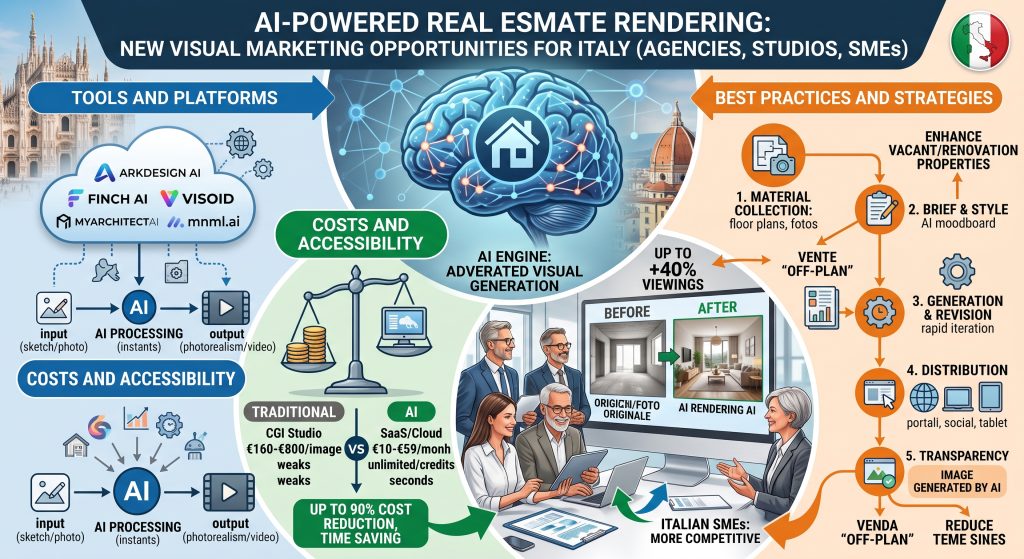
This article’s text was created with the help of AI systems and reviewed by the WIT ICT team, in accordance with Article 50 of the EU AI Act (Regulation (EU) 2024/1689) on the transparency of AI-generated content. The featured image was also generated using AI.
Searches for real estate rendering have spiked sharply in recent days, a sign that interest is spreading from architecture studios toward agencies, builders and small firms. For a small business the question is no longer “do we have a nice photo”, but how to tell the story of a space before it exists or before it is furnished. Anyone who sells, rents or designs property now has access to tools that were, until recently, the preserve of large companies. It is worth understanding what is driving this growth and how to use it without wasting money.
What real estate rendering is, and why it is surging now
Real estate rendering is the creation of photorealistic images of a building, an apartment or a room from a digital model, without photographing anything real. It comes from the design world, where it helped clients picture a project still on paper. The recent jump in searches reflects two forces meeting at once: more accessible software, and the arrival of AI image generators that cut both time and cost. The result is that even a small agency can present a property under construction with the same visual care as a major developer. This is not a passing fad; it is a professional tool entering a far wider market than before, and reaching businesses that never considered it.
From photography to 3D: what actually changes for SMBs
Photography remains irreplaceable for documenting what already exists, but it hits its limits when a property is empty, under renovation or not yet built. This is where rendering fills the gap. For a small business the practical difference shows up on three fronts:
- Speed: a room can be visualised before the first brick is laid.
- Flexibility: finishes, colours and furniture change in a few steps, with no new site visits.
- Storytelling: you communicate potential, not just the current state.
Those working in construction or brokerage can bring sales forward, ease the buyer’s uncertainty and stand out among listings that too often look identical. Photography and rendering do not compete; they complement each other across the property’s whole life cycle, from design to handover.
The artificial intelligence that speeds up visual production
Not long ago, a quality render meant days of modelling and powerful workstations. New generative AI tools change the equation: starting from a floor plan, a sketch or a photo, they produce variations of style, lighting and furnishing in minutes. This does not remove the professional; it shifts the role toward direction and quality control. For an SMB it means testing more options on the same budget and involving the client in an iterative way. Some issues still need watching: consistency across images, respect for real proportions, and fidelity to the materials that are actually available. AI speeds things up, but human oversight is what keeps the result believable and sellable, not merely eye-catching.
Virtual staging: furnishing empty rooms without moving a single sofa
Virtual staging is perhaps the most immediate use for anyone selling or renting. It means furnishing an empty room digitally, so the prospective buyer grasps its size and liveability. A bare space discourages; the same room with a sofa, a bookshelf and warm light invites people to imagine their life there. For an agency the benefit is twofold: stronger listings and no physical staging cost. It is essential, though, to state clearly that the image is a simulation, so you do not set misleading expectations before the viewing. Used honestly, virtual staging shortens negotiations and adds value even to tricky properties, such as those needing renovation or second homes out of season.
What it costs, and which tools you really need
You do not need an in-house design department to start. The market is layered, and the right choice depends on volume:
- Desktop software for modelling and rendering, for teams with technical skills and steady output.
- Cloud platforms and pay-as-you-go AI services, ideal for occasional or seasonal projects.
- External providers to whom you delegate single jobs, keeping costs predictable.
A business that publishes few listings will benefit from pay-as-you-go options; a studio designing continuously can amortise licences and training instead. The advice is to begin with a pilot, measure the impact on enquiries and sales, and only then decide whether to bring the work in-house. Buying the most expensive tools first, before you understand your real needs, is the most common mistake.
Mistakes to avoid, and the question of transparency
The power of these tools carries a responsibility. An over-idealised render that does not match reality erodes trust and can lead to disputes. A few precautions reduce the risk:
- Always declare when an image is a simulation or a project not yet built.
- Respect the property’s real dimensions, orientation and constraints.
- Avoid furniture or details that imply features not included in the sale.
On the regulatory side, Europe’s growing attention to the transparency of AI-generated content is pushing toward clearer practices in property marketing too. Communicating honestly is not only an ethical duty: it protects the brand from bad reviews and legal trouble and, paradoxically, makes the images more effective precisely because they are believable.
Fitting rendering into your digital strategy
Images alone do not sell; what matters is where and how they are used. A well-made render lifts a portal listing, feeds social channels with content that stops the scroll, and enriches the company website, where it can sit alongside real photos and video. For an SMB the winning move is to fold visual production into the wider workflow: from an optimised WordPress site to the property page and on to advertising campaigns. This is where different skills — photography, web, AI and consulting — come together in a single outcome. Whoever coordinates these pieces turns a mere search trend into a concrete commercial advantage, rather than just chasing the latest technology.
Want to know more? Contact us for a free consultation.