
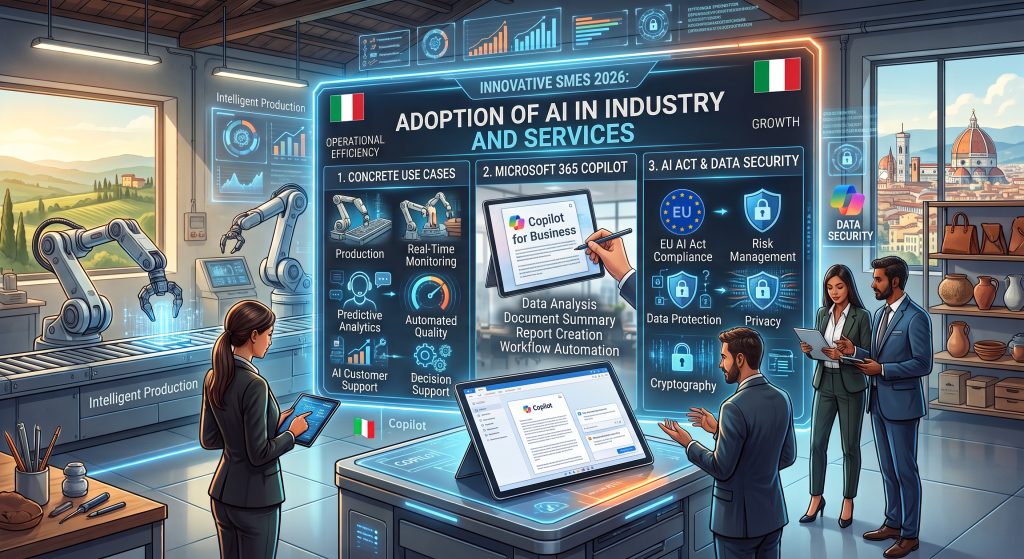
This article’s text was created with the help of AI systems and reviewed by the WIT ICT team, in accordance with Article 50 of the EU AI Act (Regulation (EU) 2024/1689) on the transparency of AI-generated content. The featured image was also generated using AI.
Interest in artificial intelligence shows no sign of cooling down. Searches on the topic have climbed again in recent weeks, helped along by a regulatory milestone: the core provisions of the EU AI Act, Regulation (EU) 2024/1689, became applicable on 2 August 2026. For a small or mid-sized business, this combination of technological momentum and legal clarity marks a shift. AI is no longer a side experiment; it is a management decision. The question is not whether to adopt it, but how to do so in a way that is useful, sustainable and compliant. This article aims to bring some order to that, starting from what actually changes in daily work.
Why AI became a real priority in 2026
Not long ago, talking about artificial intelligence at work almost always meant talking about pilot projects far removed from day-to-day operations. That has changed. Generative assistants are now built into the tools smaller companies already rely on — email, spreadsheets, business software — and that dramatically lowers the barrier to entry. There is also a very practical competitive pressure at play: when a rival answers customers in half the time or drafts a quote in minutes, the gap is felt quickly. A cost factor matters too: most of these tools now come with modest monthly fees within reach of even a micro-business, which removes the budget excuse that postponed the conversation for years. AI has moved into ordinary management precisely because it touches the two levers every business owner understands: people’s time and the quality of service.
Where SMBs see measurable results
The value of artificial intelligence shows up when it is applied to repetitive, high-volume tasks, not when novelty is chased for its own sake. A few areas where smaller companies are gathering concrete benefits:
- Customer support: guided replies, request routing and email drafts that staff then refine.
- Document handling: pulling data from invoices and contracts, summarising long documents, searching internal archives.
- Marketing and sales: first drafts of copy, product descriptions, adapting content for different channels.
- Analysis and forecasting: quickly reading stock or sales figures to anticipate reorders and seasonality.
The common thread is that AI speeds up the mechanical part and leaves the final decision to people, which remains the real added value.
Generative assistants in everyday work
Tools such as Microsoft 365 Copilot illustrate the direction of travel well: artificial intelligence is no longer a separate application to open, but a feature living inside Word, Excel, Outlook and Teams. Meeting notes turn into a task list, a raw table becomes a readable summary, a long email thread is condensed into three lines. For an SMB the advantage is twofold: you build on an environment staff already know, and you cut the time spent on low-value activities. The catch is that it only works with tidy data and well-configured permissions — otherwise the assistant works from incomplete information or, worse, surfaces something a person should not see.
The AI Act and the new transparency duties
The European legal framework is now operational. Regulation (EU) 2024/1689 has been in force since 1 August 2024, with a phased rollout: bans on the riskiest practices apply from February 2025, rules for general-purpose AI models from August 2025, and most remaining obligations — including the transparency requirements under Article 50 — from 2 August 2026. In practical terms, anyone generating content with AI or letting users interact with automated systems must make that recognisable. It is the reason for the note at the top of this article. There is also an obligation often overlooked but already effective since February 2025: ensuring an adequate level of AI literacy among those who use these systems at work, which in practice means a duty to train staff. And there is a note of balance for smaller firms: penalties are set at proportionally lower levels than for large enterprises, but the obligations still apply, and a sensible first move is to map which AI systems the company actually uses.
Data, security and governance: foundations you cannot skip
No intelligent assistant makes up for a messy foundation. Before adopting AI it pays to clarify three things: what data we handle, where it lives and who can access it. Uploading confidential information to non-corporate tools, for instance, creates risks that no efficiency gain justifies. A few measures we recommend to the businesses we work with:
- prefer solutions that keep data within the company perimeter or on contractually governed services;
- set a simple internal policy on what may and may not be entered into AI tools;
- enable multi-factor authentication and review access permissions periodically.
Cybersecurity, in other words, is not a separate chapter but the precondition for any artificial intelligence project.
How to start without waste: a step-by-step path
The most common mistake is starting from the tool rather than the problem. A sturdier approach moves in stages. You pick a process that genuinely weighs on the business — many hours, many errors, a lot of repetition — and use it as a testing ground. You then choose a tool suited to that single case, train whoever will use it, and measure the outcome after a few weeks against clear criteria: time saved, quality, and the satisfaction of the people doing the work. Only then does it make sense to extend the method to other tasks. This way of proceeding avoids reckless spending and, above all, builds trust among staff, who come to see AI as help rather than a threat.
The most frequent mistakes to avoid
Anyone guiding SMBs through these projects recognises a handful of recurring missteps. The first is handing AI decisions that call for human judgement, forgetting that these systems can produce answers that sound plausible but are wrong. The second is neglecting training: a powerful tool in unprepared hands breeds confusion, not productivity. The third is the absence of a human review of content before it is published or sent to a client. Finally there is the “everything at once” illusion: those who try to transform every process in one go rarely deliver results, while those who consolidate one case at a time build lasting capability. Artificial intelligence rewards methodical patience more than improvised enthusiasm.
Want to know more? Contact us for a free consultation.